
After a long silence
The emerging history of American Contrabands

This Substack post’s title and subheadline are borrowed from the two-part name of next month’s free-to-attend symposium at Fort Monroe (on Point Comfort, Virginia, the 1619 place). On May 22 and May 23, the panel sessions of “After a long silence: The emerging history of American Contrabands” will shine new national light illuminating what’s been recurringly predicted here in The Self-Emancipator: “Nothing is more certainly written in the book of fate than that Americans will esteem the Civil War’s multitudes of freedom-striving, emancipation-forcing slavery escapees.”1
The symposium’s organizers at the Contraband Historical Society have recognized that the time has come for emphasizing national attention to the Contraband story, which began at Fort Monroe in May 1861, weeks after Fort Sumter. They telegraph this recognition in their symposium’s name. More than in the past for historical remembrance of the Contrabands, views from beyond Virginia will be involved.
One slated participant is Tom Zoellner, professor at Chapman University and Dartmouth College and a former staff writer for The Arizona Republic and the San Francisco Chronicle. His writing has appeared in The Atlantic, Harper’s, The American Scholar, The Oxford American, Time, Foreign Policy, Slate, Scientific American, Audubon, Sierra, The Los Angeles Times, The New York Times, The Texas Observer, The American Scholar, and The Wall Street Journal. He’s an editor-at-large for the Los Angeles Review of Books. His nine nonfiction books include Island on Fire: The Revolt that Ended Slavery in the British Empire, which won the National Book Critics Circle Award for the best nonfiction book of 2020.
Recently Zoellner also published The Road Was Full of Thorns: Running Toward Freedom in the American Civil War. (I posted about it in December.) The book jacket provides a pithy summary:
In the opening days of the Civil War, three enslaved men approached the gates of Fort Monroe, a U.S. military installation in Virginia. In a snap decision, the fort’s commander “confiscated” them as contraband of war.
From then on, wherever the U.S. Army traveled, torrents of runaways rushed to secure their own freedom, a mass movement of 800,000 people2—a fifth of the enslaved population of the South—that set the institution of slavery on a path to destruction.
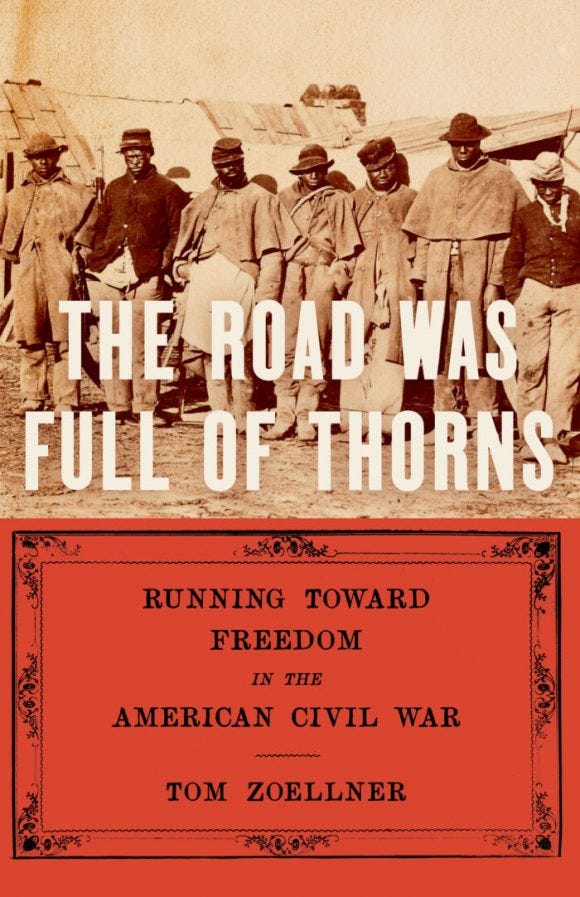
The book’s circa 1864 cover photo has appeared widely. In the National Trust for Historic Preservation essay “The Forgotten: The Contraband of America and the Road to Freedom” the photo’s caption begins, “A group of African American refugees, called contraband, who worked for the Union army as teamsters.” Contrabands figured centrally in the war’s gradual elevation from a struggle for union to a struggle for union and freedom. Zoellner’s book can inspire unforgetting of the Civil War’s multitudes of slavery escapees, whether called Contrabands—with a capital C, as the Contraband Historical Society advocates3—or self-emancipators. Princeton’s Sean Wilentz cites “hundreds of thousands” of Civil War slavery escapees “forcing the issue of freedom, which helped change a war to crush southern secession into a war to destroy slavery.”
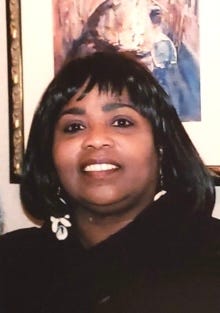
The late Gerri Hollins, a Contraband descendant like others in the Contraband Historical Society, founded the society in Tidewater Virginia in 1994. The society’s website says she “worked tirelessly until her death in 2012 to bring this often ignored history to the public’s attention.” Often ignored, indeed. When the Pentagon announced in 2005 that the Army would retire Fort Monroe in 2011 and return it to Virginia, I already had three decades of connections to it. Yet I didn’t know of the Contrabands. In 2006, after Gerri had joined the political effort to achieve something better than overdevelopment of post-Army Fort Monroe, she and I were standing next to the Lincoln Gun at Fort Monroe when she opened my eyes to the Contraband story.
Tom Zoellner will be a panelist at the May symposium. So will:
Filmmaker Laura Seltzer-Duny, whose work has aired on PBS, CNN, MSNBC, CBS, NBC, Discovery, and the History Channel. She’s working on “THE GATE: The Story of America’s First Contraband Community” (5-minute trailer).
Amy Murrell Taylor, University of Kentucky scholar of self-emancipation and author of Embattled Freedom: Journeys through the Civil War’s Slave Refugee Camps and The Divided Family in Civil War America.
Abigail Cooper of Brandeis University, who studies the Civil War’s contraband camps.
Chandra Manning of Georgetown University, author of Troubled Refuge: Struggling for Freedom in the Civil War.
Cassandra Newby-Alexander, Endowed Professor of Virginia Black History and Culture at Norfolk State University and author of Daily Life along the Underground Railroad and Virginia Waterways and the Underground Railroad. She has appeared on NBC, BBC, C-SPAN, and in PBS’s Henry Louis Gates Jr. production The African Americans: Many Rivers to Cross.
Postscript
During the Civil War centennial, 1961 to 1965, I was a kid, interested in the Civil War only as a stirring pageant of battles and generals and valor, same as everybody else. By the turn of the century, now middle-aged, I knew that emancipation and abolition were important, but Lost Cause propaganda still had a subtle hold.
In those circa 2000 years my family and I often visited Fort Monroe. It was a post with high-level importance for the Army—a restful, wooded seaside place with dignified residential and campuslike architecture. Our children loved it. We attended the weekly summertime outdoor concerts on a grand lawn beside the bay. Kids and dogs played with Frisbees and tennis balls at one end. At the other, near the bandstand, grownups drank wine—discreetly—and enjoyed the music. It was something like stepping into Bedford Falls in It’s a Wonderful Life.
Then something changed. In 2005, the Pentagon announced the Army’s 2011 departure and Fort Monroe’s 2011 reversion to Virginia ownership. Given the post’s essential nature as hugely attractive waterfront, it immediately became necessary to defend the precious spirit of place from the threat of thoughtless overdevelopment. That necessity in turn necessitated learning more about the historical importance. Yet most of the people I knew, including me, still didn’t know about the world history—not just American history, but world history—that gave rise to the Contrabands.
But that was two decades ago. Now, in 2026, the Black and indigenous history of this cherished place is generating awareness. At Fort Monroe on April 20, just the other day, at a bayfront spot with a clear view down the bay to the Atlantic Ocean, a gathering of many hundreds, led by Governor Spanberger, formally dedicated the African Landing Memorial. It’s a formal stone plaza oriented to point toward the Atlantic, crossed centuries ago by multitudes torturously confined and enslaved.
Members of the Contraband Historical Society were present. The president, Phil Adderley, an old friend and Jefferson Lab colleague of mine, was especially busy making something happen—something that in 1961, and in 1981, and in 2001, even with all my familiarity with Fort Monroe, I could never have foreseen. I didn’t know the history.
But now, along with many others, I do know, and know that the Contraband Historical Society signals something hopeful about the future. The scope and vision of its May symposium are new. Something missing from the national story is being reclaimed—at the Virginia place where slavery began and, a quarter millennium later, began to crumble.
A Thomas Jefferson quotation on the wall of the Jefferson Memorial in Washington begins, “Nothing is more certainly written in the book of fate than that these people are to be free.”
Estimates vary; the figure some scholars use is a half million.
https://contrabandhistoricalsociety.com/#section_one “We capitalize Contrabands to emphasize peoplehood, community, and historical agency, not property status, recognizing that ‘contraband’ began as an imposed military term, but the people so labeled made it mean freedom claimed, families protected, and communities built.”
Best wishes for your conference! Surprised to see the name of Tom Zoellner, recently of the San Francisco Chronicle.
If you remember, remember this Chron subscriber of >50 years, and tell him that my mom was one of the "foo foo woo woos". She saved up her timeshare trades for 5 years to get a week exchange in Sedona. We joined my parents and saw all the alleged alien landing spots while she rehearsed intergalactic greeting phrases. She enjoyed Sedona so much that I don't think she minded no aliens shaking her hand.
Will try to get his book, too. (Kevin Levin's recommendation, on the weather at Gettysburg, just arrived, and then we're off to see him this weekend in Monterey, so the reading list is long.)
Some day we would like to visit Fort Monroe.
Will the symposium be streamed or recorded? Some who are interested live far away!