
Contrabands unforgotten
"Running toward freedom in the Civil War"

PLEASE FORWARD THIS SHORT ESSAY. It’s the 37th Self-Emancipator post since the very brief introductory “Why The Self-Emancipator?” on Juneteenth two and a half years ago. This nonpaywalled Substack newsletter monitors and advocates the delayed but growing national esteem for the Civil War’s multitudes of freedom-striving slavery escapees. The antebellum abolitionist publication The Emancipator inspired The Self-Emancipator’s name.
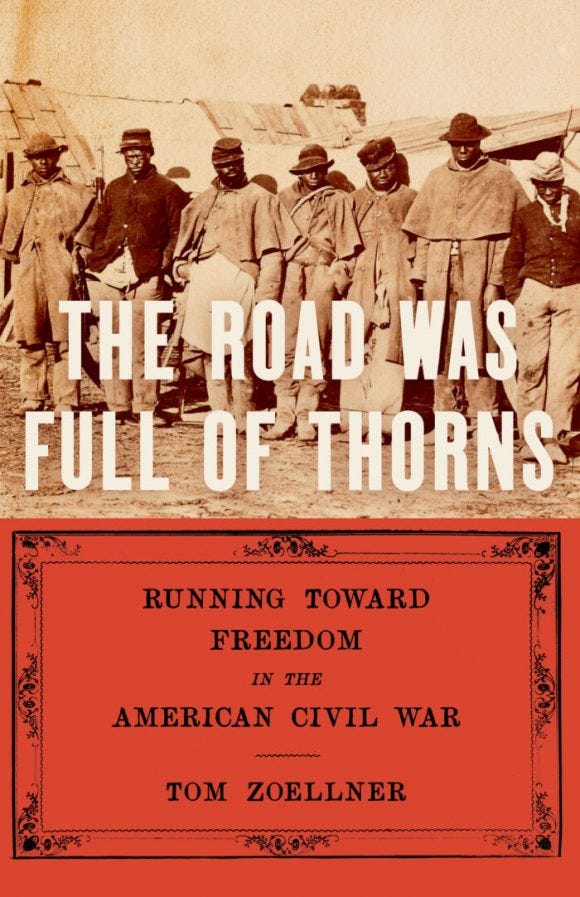
The circa 1864 cover photo on Tom Zoellner’s The Road Was Full of Thorns: Running Toward Freedom in the American Civil War has appeared widely. In the National Trust for Historic Preservation essay “The Forgotten: The Contraband of America and the Road to Freedom” its caption begins “A group of African American refugees, called contraband, who worked for the Union army as teamsters.” Zoellner’s book can inspire unforgetting of the Civil War’s multitudes of slavery escapees, whether called contrabands or self-emancipators. They figured centrally in the war’s gradual elevation from a struggle for union to a struggle for union and freedom.
From the book jacket’s front inside flap:
In the opening days of the Civil War, three enslaved men approached the gates of Fort Monroe, a U.S. military installation in Virginia. In a snap decision, the fort’s commander “confiscated” them as contraband of war.
From then on, wherever the U.S. Army traveled, torrents of runaways rushed to secure their own freedom, a mass movement of 800,0001 people—a fifth of the enslaved population of the South—that set the institution of slavery on a path to destruction.
A fall 2025 interviewer asked Zoellner what he hopes readers will walk away with after reading about those multitudes and that path. His answer: “Admiration for the courage of the enslaved people who endured terrible trials in the cause of freedom.” Self-Emancipator subscribers (it’s free; a cause, not a business) won’t be surprised to see Zoellner’s pithy wish likened to a prediction that recurs regularly here. It’s phrased to echo Thomas Jefferson’s 1821 prediction2 of slavery’s demise:
Nothing is more certainly written in the book of fate than that Americans will esteem the Civil War’s multitudes of freedom-striving, emancipation-forcing slavery escapees. Just not yet.
Zoellner’s new book could defray the just-not-yet. That’s why I’m about to ask you to pause and invest a total of three minutes in two musical YouTube clips. It’s not because readers would lack a general sense of each. It’s because when actually experienced within the moment, what the two songs can powerfully stir frames this essay’s point: This new book shows what American Historical Association then-president Thavolia Glymph meant in 2024 when she wrote that with the growth of what she called “the archives of slavery’s destruction,” she believes a time will come for general, grateful remembrance of Civil War Black Americans’ part “in the making of a new birth of freedom.”3
Zoellner’s chapter “Let my people go” ends by quoting a reporter’s observation, at the time of the Emancipation Proclamation, that the let-my-people-go freedom hymn “Go down, Moses”—“a kind of national hymn turned proclamation”—was the “negro Marseillaise.” The chapter’s final lines: “Go down, Moses/ Way down in Egypt land/ Tell old Pharaoh/ Let my people GO.”
You don’t need to know the 1942 movie Casablanca—or know about World War II nazi influence in French Morocco—to be stirred by the exuberant musical defiance in the movie’s “Play La Marseillaise!” scene. Please pause and watch a two-minute video clip.
And you don’t need to have witnessed Civil War contrabands singing the let-my-people-go hymn to be moved by Paul Robeson’s twentieth-century interpretation. Please pause and listen to the first 50 seconds of a three-minute recording.
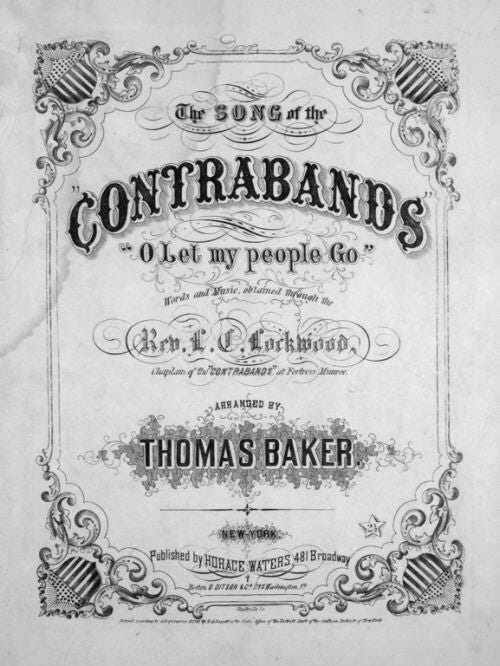
1861 sheet music cover page for the freedom hymn that the enslaved could only sing clandestinely—but that contrabands, having long been held back from coming into their own as Americans, sang openly, with passion. (Library Company of Philadelphia)
A map in the front matter of The Road Was Full of Thorns shows contraband camps dotting the Confederate and border states, with a few in Union states. The epilogue opens by regretting that the camps “faded from the collective memory of America,” but then explains that their stories did endure “well into the twentieth century, bearing witness to a part of history often overlooked yet deeply transformative. Most of the individual stories of struggle and victories were not preserved in documents and have been irrecoverably lost. But a few are known.”
Yes, a few. And Zoellner makes sure to convey some of what’s stirring about some representative cases.
He focuses mostly on the Tidewater Virginia origins—the Fort Monroe origins—of the contraband phenomenon.4 He records the observation of the Boston minister Arthur Fuller, a Harvard graduate, hearing the contrabands congregated near Fort Monroe: “To-day these are not slaves, they are men.” Fuller heard “the singing at the evening prayer meetings [as] a genuine spiritual outpouring … with frequent references to the Exodus story.” He reports the view of the missionary Lewis Lockwood—named on the sheet music cover in the illustration above—that the refugees had “a deep impression they were the second children of Israel.”5
He tells about George Scott, a pre-war slavery escapee who overcame and disarmed his former “owner” and, using his local knowledge, became a valued scout and spy for the Union. He tells about Samuel Bolton, who became a Union army cook, but went back into Confederate territory to rescue his wife Rebecca. Bolton “would think of it for years as the proudest moment of his life.” Later, Bolton was among the first Black soldiers to enter Richmond. Zoellner tells of Peter Bruner, who got to freedom on his fourth attempt by trying the U.S. Army, and became a recruiter. He tells of Henry Jarvis, an “example of raw courage,” who escaped by water to Fort Monroe, and told the commanding general that the conflict “had got to be a black man’s war for sure.” There was also, among others, the self-emancipator Jerry Sutton, “the eventual stepfather to the great-great-grandmother” of Michelle Obama.
He also tells of Robert Langley Brooks, who self-emancipated from Mathews County and traveled in a stolen boat down the Chesapeake Bay and across the wide mouth of the York River to Fort Monroe. The book ends by reporting on Brooks’s great-granddaughter Edith Taylor, born in 1924 in segregated Hampton. The final sentence: “She never let her children forget they were the descendants of Robert Langley Brooks, who paddled away from his cruel master toward the American flag and did not look back.” Contrabands unforgotten.
The “Let My People Go” chapter declares that “no force seemed able to stem the enthusiasm among Black men to take up arms against the Confederates.” That calls to mind Chinese human-rights activist Liu Xiaobo’s Nobel Peace Prize speech assertion that “no force...can put an end to the human quest for freedom.” Merely coincidental parallelism links the two statements syntactically, but their fundamental parallelism links them within the realm of human rights, the realm that America’s self-emancipating contrabands illuminated. To what extent will they be remembered in the celebrations of 2026?

Dissident Liu Xiaobo’s Nobel Prize speech, read in Oslo by Liv Ullman because Chinese tyrants forbade his travel, declared “No force...can put an end to the human quest for freedom.” He was in prison in China for “inciting the subversion of state power.” It was his fourth such prison spell.
Estimates vary; the figure some scholars use is a half million.
“Nothing is more certainly written in the book of fate than that these people are to be free.” Part of an inscription on the wall of the Jefferson Memorial in Washington, D.C.
Duke University Professor Glymph noted also, without explicit comment, that a 1939 Georgia Historical Quarterly article had called this idea “an absurd bit of propaganda, based on a perversion of historical facts.”
Beautiful, Steve—thank you. I loved Tom’s chapter, “Let My People Go,” and was especially struck by Thavolia Glymph’s sense of optimism about where this history is headed.
I hope you’ll plan to attend our first national symposium, After a Long Silence: The Emerging History of the American Contrabands, this spring at Fort Monroe. The Save the Dates will be going out soon.
And speaking of music: at their first Christmas Eve in freedom in 1861, the Contrabands gathered with Union officers, soldiers, teachers, and Contraband children in a classroom at the Female Seminary in Hampton. Together, with the children leading the way, they opened the evening’s program by singing “My Country, ’Tis of Thee.” Happy Holidays. L
Thanks, Steve. Beautiful essay on this powerful book. I’m reading it now. When you get the dates for the conference, please share.